Trip to Sierra Leone
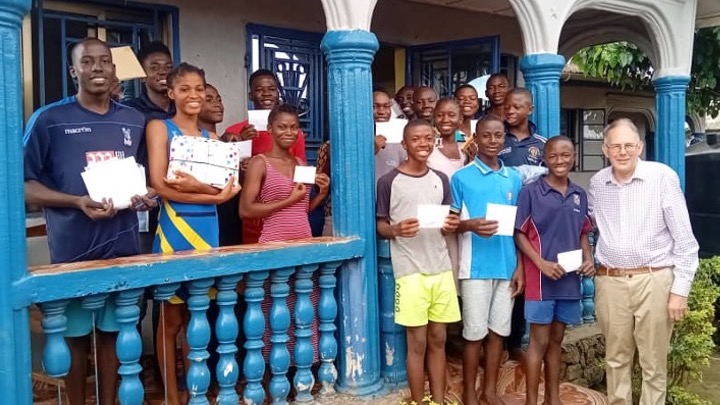
In late September Jonathan Redmayne and his university friend, Paul Martin, travelled to Sierra Leone on behalf of SLM. Read below Jonathan's account of their trip:
It was our first time in West Africa and was a wonderfully uplifting experience, but at times it also left us wanting to weep.
Like Janet and other members of the SLM Committee, we stayed at Bethesda Children’s Centre, in the part of the building known as the Missionary Quarters. In spite of having discussed it on countless occasions in committee meetings, it bore little relation to what I had expected. It sits beside a noisy dual carriageway, built by the Chinese, and is surrounded by high walls topped with broken glass and barbed wire, which engenders something of a fortress mentality. Magnus explained this was essential to prevent thieves from breaking in.
In spite of, or perhaps partly because of this, Bethesda felt a place of sanctuary and it was a great privilege for us to stay there for a fortnight or so and get to know the young people in quite an intense way. All of them are former street children, who were once essentially without hope, and we witnessed lives which, under Magnus’ gentle but wise supervision, had been transformed materially, educationally and spiritually. It is a remarkable statistic that ten of the eighteen young people are currently at university, of whom two, Abdul and Mariatu, are about to graduate.
And yet, although their lives are incomparably better than they would otherwise be, from our Western perspective they have remarkably little. While an elevated tank provides running water for the Missionary Quarters, it is insufficient to supply water for the rest of the building and they have to draw water manually from a borehole within the compound. ‘Taking a shower’ for the young people involves pouring a bucket of cold water over themselves and the ‘kitchen’ comprises an external hut open to the elements and shared with chickens and lizards, with rickety wooden benches on either side of a fire, with a heavy iron pan above it, in which all of the food is cooked.
Getting anything done appears to be a heroic endeavour, requiring ingenuity, perseverance and the patience of Job. And so, whenever we asked Issa, who is now in his final year at university and doing Computer Studies, to print off any documents for us, it would often take him over an hour with an elderly printer and intermittent electricity supply and, if, as frequently happened, the printer cartridge ran out of ink, the only practical solution was for him refill it manually, as new cartridges were too expensive or simply unavailable.
Notwithstanding the frustrations of daily life, however, there was a palpable sense of joy and contentment at Bethesda, which we also found elsewhere on our trip but which is perhaps absent in the lives of many in the UK and the West more generally, in spite of our being so much better off materially. Magnus told us that most people in Sierra Leone are thankful if they have a single meal each day.
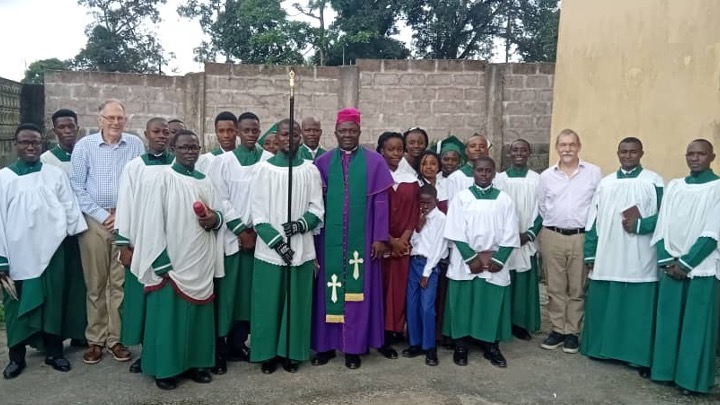
That overwhelming sense of joy was also evident in the morning service we attended at St Mark’s Cathedral in Waterloo on the second Sunday of our trip, which lasted for nearly three hours. It was a curious but rather wonderful blend of formality, with a robed choir, an Anglican liturgy and Magnus in ecclesiastical purple, on the one hand and uninhibited African worship on the other. The singing of eighteenth-century hymns written by the likes of Augustus Toplady and Frances Havergal, which would have been familiar to the Countess, gave way seamlessly to Gospel music sung with gusto by four ladies, at which point the female choristers began to sway gently and the congregation to dance.
But even amidst such joy, there was a poignant reminder of Sierra Leone’s recent brutal history. A memorial plaque, just inside the entrance to the Cathedral, recorded the deaths of nineteen members of the congregation on a single day in the summer of 1999, towards the end of the Civil War, when they were murdered by rebels from the Revolutionary United Front, as they entered Waterloo.
Paul, who is a retired RE teacher, was asked by Magnus to teach English to two classes, the first aged 11-12 in the Junior Secondary School and the second aged 15-16 in the Senior Secondary School at Fufu Water run by the Sierra Leone Connexion (the ‘Connexion’). The children in both classes were of mixed ability, to an extent which made it difficult for Paul to pitch his teaching at the right level, but, even though there was greater understanding among some of the children in the older class, they clearly found it difficult to think in English or express things in their own words.
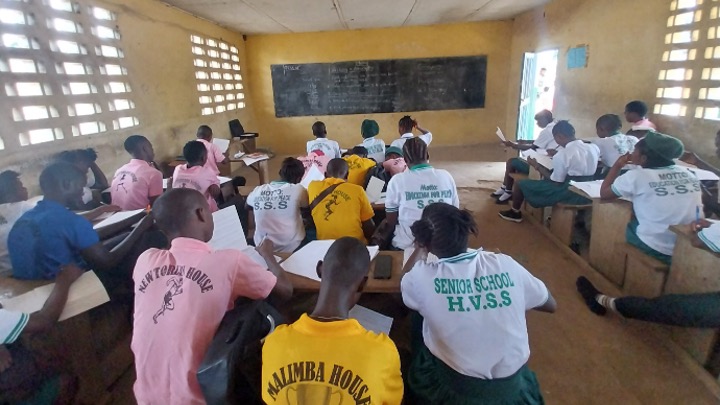
This may not be entirely surprising as some of the teachers themselves have quite limited English and struggle to read it and a number are without teaching qualifications. This is exacerbated by old-fashioned teaching methods, which encourage children to learn by rote rather than engage in discussion or think for themselves. Undoubtedly the lack of resources and poor state of the classrooms are also a significant factor. Few, if any, of the children have textbooks and many of the classrooms are quite dark, being without electricity and having windows with heavy mouldings, intended to prevent thieves breaking in, which restrict the light and strain the eyes of both pupils and teachers.
The shortcomings in the state of classrooms are even more acute in Connexional primary schools and this was evident both at Fufu Water itself and the various other schools we visited in urban and rural areas. In some cases, classrooms were barely usable during the rainy season because the roof leaked. In other cases, there were no ceilings, so that, in the dry season in particular, conditions within the classroom were sweltering. Some blocks lacked any proper partitioning between individual classrooms, so that the children were constantly distracted by noise from the adjoining classes. A measure of the extreme difficulties faced was evident at one rural primary school we visited, in Magbafti. The headteacher showed me an external toilet block, serving both children and staff, from which all of the doors had recently been stolen.
Another serious challenge facing Connexional primary schools is the very high numbers of children they have to accommodate and the resulting class sizes, many having over sixty children and some even over seventy, but with a single teacher in charge. It is difficult to see how a child can have a proper education in these circumstances. This is in large part because of the legal status of Connexional primary schools, most, if not all, of which are deemed to be Government-aided because the headteacher and some of the staff receive Government salaries and are therefore its employees. The majority of the teachers, however, receive no remuneration from the Government and about a hundred are largely dependent for their income on the monthly grants from SLM (£22 per month per teacher, equivalent to half of the national minimum wage in Sierra Leone). This figure excludes a significant number of community teachers, who receive no remuneration from the Government or support from SLM.
As a result of this legal status, Connexional primary schools are required by law to admit any children whose parents wish them to go there, and are unable to set any limit on the number entering the school, even if the classroom accommodation is insufficient. This problem is particularly acute for primary schools in rural villages, where the birth rate tends to be higher than in urban areas. A further consequence of this status is that schools are not allowed by law to charge fees. This is compounded by the tiny allowance the Government gives each primary school for maintaining and improving its buildings (equivalent to 36 pence per child per year) and inevitably means the financial burden of maintaining school buildings and putting up new ones to accommodate the extra children falls almost exclusively on the Connexion, and therefore by extension SLM.
As a retired property lawyer, my primary task was to review the title deeds for the schools, churches and other properties run by the Connexion and then make a presentation to the trustees of my findings and advise them on the best way forward.
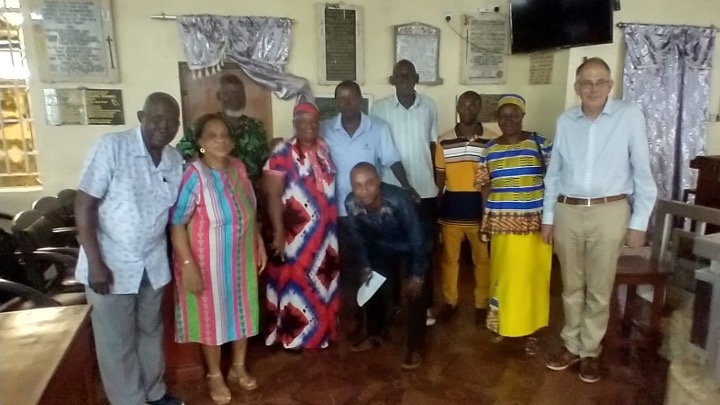
I took as my starting point their duties under the Connexion’s constitution. These are not only to sign the relevant documents for any acquisition or disposal of property but also, more generally, to manage all of the properties owned by the Connexion. This came as something of a revelation to the trustees.
My findings were fourfold.
First many of the transactions had been left uncompleted and the documentation was limited to a measured plan prepared by a licensed surveyor, a receipt from the vendor for the purchase monies and perhaps a land sale agreement, but without any conveyance to the Connexion. While understandable because of all of the costs incurred in the conveyancing process in Sierra Leone, not least because everyone involved, even an independent witness to a signature, took the opportunity to charge for their services, it meant that legal title to the land in question had never passed to the Connexion.
Secondly, even in those cases where transactions had been completed and the conveyances registered at the Office of the Administrator General in Freetown (and the necessary tax paid), often those conveyances were in favour of a non-existent entity - an attempted amalgam of the Connexion itself and a UK company used to purchase land where SLM provided the funds. As a result, again legal title had never passed to the Connexion and remained with the vendor.
Thirdly in a number of cases the deeds to a property had been lost or mislaid, which meant the Connexion was unable to provide any evidence of its title.
And finally in many cases the physical boundaries had not been properly marked on the ground and the extent of the land owned by the Connexion was therefore often unclear.
My conclusion was that for all these reasons the properties owned by the Connexion were vulnerable to encroachment but that there was a potential solution - the doctrine of adverse possession. This allows someone, who has occupied land in Sierra Leone for more than twelve years and held themselves out as the legal owner without challenge, to claim legal title to that land and have themselves registered as the legal owner, so long as they can provide statutory declarations to this effect. The alternative would be to go cap in hand to the original vendor (or his family) and ask for a conveyance of the land. This would, however, mean the cat was out of the bag and almost certainly be seen by the vendor or his family as an opportunity to extract substantial further funds from the Connexion, even though they might be legally obliged to convey the land.
All of this may sound rather dry and dusty but it really matters. The Connexion can only carry on its existing activities through its properties, whether that be churches, schools, Bethesda or the Health Centre. If it loses the right to use them, its ability to continue proclaiming the Gospel, rescuing street children and providing a Christian education and healthcare is in jeopardy. Realistically, however, it could take ten years or perhaps even longer to resolve all of these issues.
Why these things do really matter is painfully illustrated by what happened at King James Primary School. In 2014/15 the Chinese wanted to build a factory on adjoining land and incorporate a large part of the school’s existing site. The site was owned by the Government but had been let to the Connexion. Unfortunately the Connexion had lost its copy of the lease and could not therefore prove its right to occupy the site and was unable to prevent the Government from giving three quarters of the site to the Chinese.
As a quid pro quo, the Chinese agreed to pay for a new classroom block to be built on the remainder of the site but reneged on that promise. Save the Children then offered to pay for the new block but changed their mind and decided to spend the funds elsewhere. As a result of this unhappy saga, the Connexion had no option but to put up a temporary classroom block five years ago. We visited this block, which resembled a cattle shed, and witnessed for ourselves the dire conditions. Over 200 children were being taught in semi-darkness in four separate classes but with barely any partitions between them and under a corrugated iron roof without ceilings, which would, we imagine, have been unbearably hot in the dry season.
It is easy to feel despair when you see such things but our abiding memory of our trip to Sierra Leone is of a sense of joy, hope, and contentment amidst all the struggles of daily life. I think we have much to learn from their example.
Jonathan Redmayne