What's New?

Crying out to God

Paul Woodbridge explores the Psalms as a means to express sadness.

Some scenarios

How have you felt over the past two years? At times, despondent and wondering what was going on? Where has God been during the Covid pandemic? As we have been prevented from doing all we would like to do both as churches and individuals, how have you responded?

And how do we react when things go wrong in our lives, when unexpected suffering happens, and we’re tempted to ask ‘Why God?’ But isn’t it rather ungodly to be negative in difficult situations? After all, didn’t the apostle Paul say, ‘Rejoice in the Lord always. I will say it again: rejoice!’ (Phil.4:4). And that was when he was in prison, itself an unpleasant experience. 

I became a Christian in July 1965 (together with my parents and sister). As I look back over 57 years as a Christian and think about my life and work, I also think about what has most hindered Christian growth. It’s the whole issue of suffering, especially the type of suffering that seems to have little purpose and causes great sadness and grief both to the sufferer and family and friends, and seems pointless. I have struggled to know how to deal with this.

Let me give you some examples

1. The sudden death of the Principal of Oak Hill College, where I taught for 30 years, Mike Ovey, on 7th Jan 2017 at the age of 58, provoked sad emotions in me and in the whole college, just at a point in the college’s life when Mike was about to embark on new initiatives. What was God up to??

2. The sudden death of a 27 year old student in March 2000, leaving behind a wife who had been struggling with post-natal depression and 2 young children. What was God doing? Where was he in these tragedies?

3. My mother had dementia for the last 5 years of her life. It changed her character and personality, she became angry and bitter, even telling the pastor to ‘bugger off’ when he came to visit her. It was the first time I’d ever heard her use that language!

How does God want us to react to such scenarios?

Can we be angry with God? Can I express my anger in prayer? Can I express my utter frustrations with him, when I cannot see the point in some suffering that I or others are going through? A former colleague at Oak Hill College, Eric Ortlund, begins to suggest a way for us, both individually and corporately.

Imagine you are going to church. The worship band is on stage. You see on the screen all the normal information: Copyright Vineyard Music, 1998; in the key of B flat, written by Brian Doerkson. The worship band starts up, but you notice something strange, because the song says a lot of things to God that sound rude:

'Lord, how could you let that happen? Why did you abandon me? I'm one of your own. Why didn't you protect me? If you had been there, this never would have happened (John 11:21)! And this hurts your cause too, Lord. People are scoffing at you in your absence. Come and visibly intervene for me! But no matter what, I will trust you forever. No matter what, you are my God forever.'

That's the situation we get in the Book of Psalms: a miktam, of David, to the tune of “Doe of the Dawn” - those titles head the hymns we approve and also the laments that strike us as rude. But both equally count as worship in the Bible, even though for many of us, asking lament-type questions sounds like the opposite of worship.

Could I suggest, knowing I'm generalising, that we in North America (and Britain) need to “biblicise” and complicate our worship by making lament a regular feature? To be a real biblical lament, it has to include a confession of trust and unconditional loyalty from the lamenter; without that, it's just complaining. But I also want to emphasise that, unless we lament, we're being unbiblical and unhelpful.

So, what does the word ‘Lament’ mean in the bible?

To Lament: ‘To mourn aloud, to express sorrow, mourning, or regret; to regret strongly’. And God has given us in the Psalms a way, a means, to express to him our sadness, frustration, grief, even anger, at what has happened to us.

Next I will explore some specific Psalms and see how they help us when we or others are suffering.

Paul Woodbridge 
Worship through Music

During the early days of the Covid pandemic, a group of musicians from Wormley Free Church set up the Wormley Lockdown Band.

The group started producing their own versions of popular worship songs and hymns that could be included in Wormley's online services during the period of church closures.

Since then, both audio and video versions of the band's recordings have continued to be available for all to enjoy.

To access click on the link below.

Wormley Lockdown Band Recordings


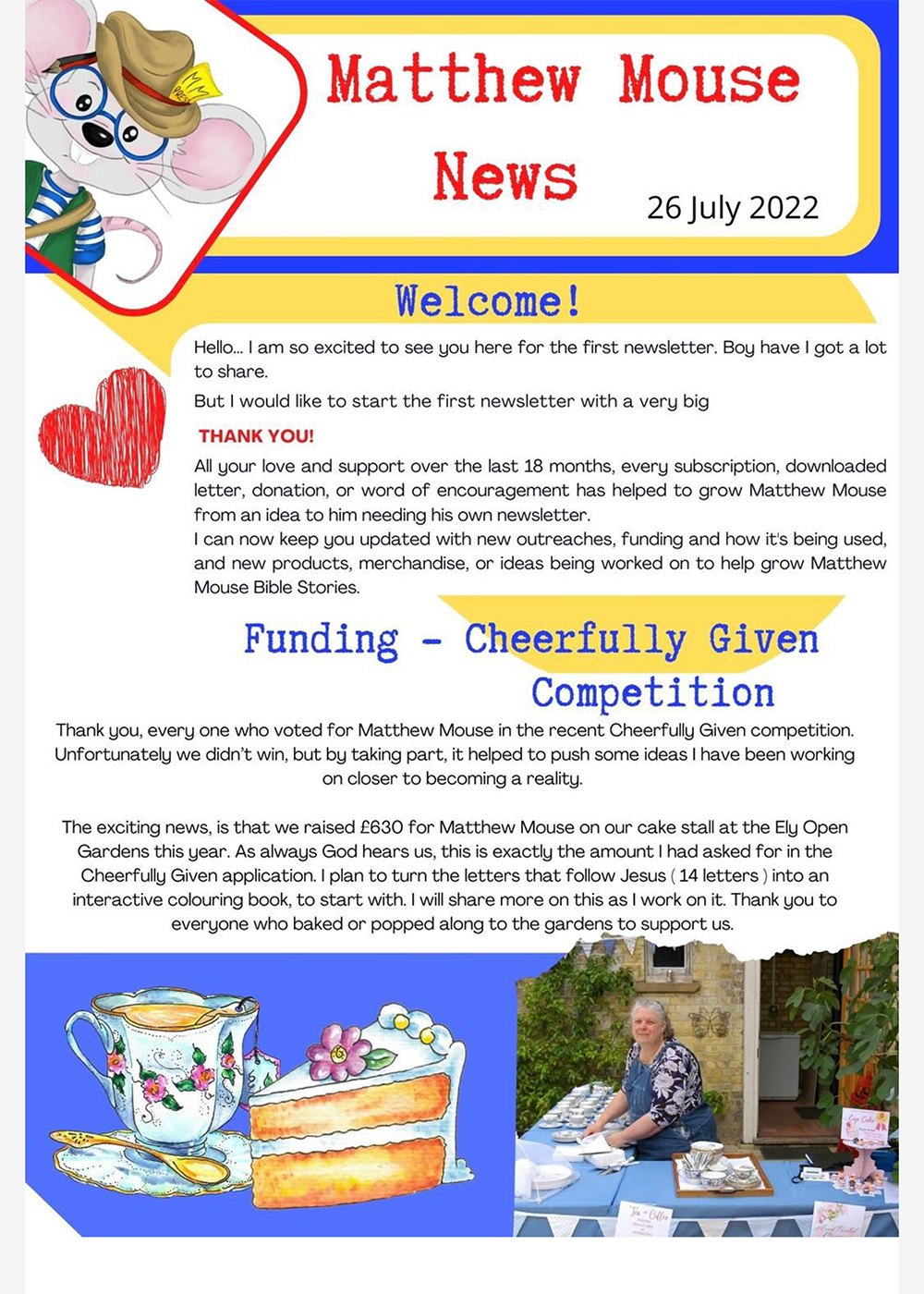
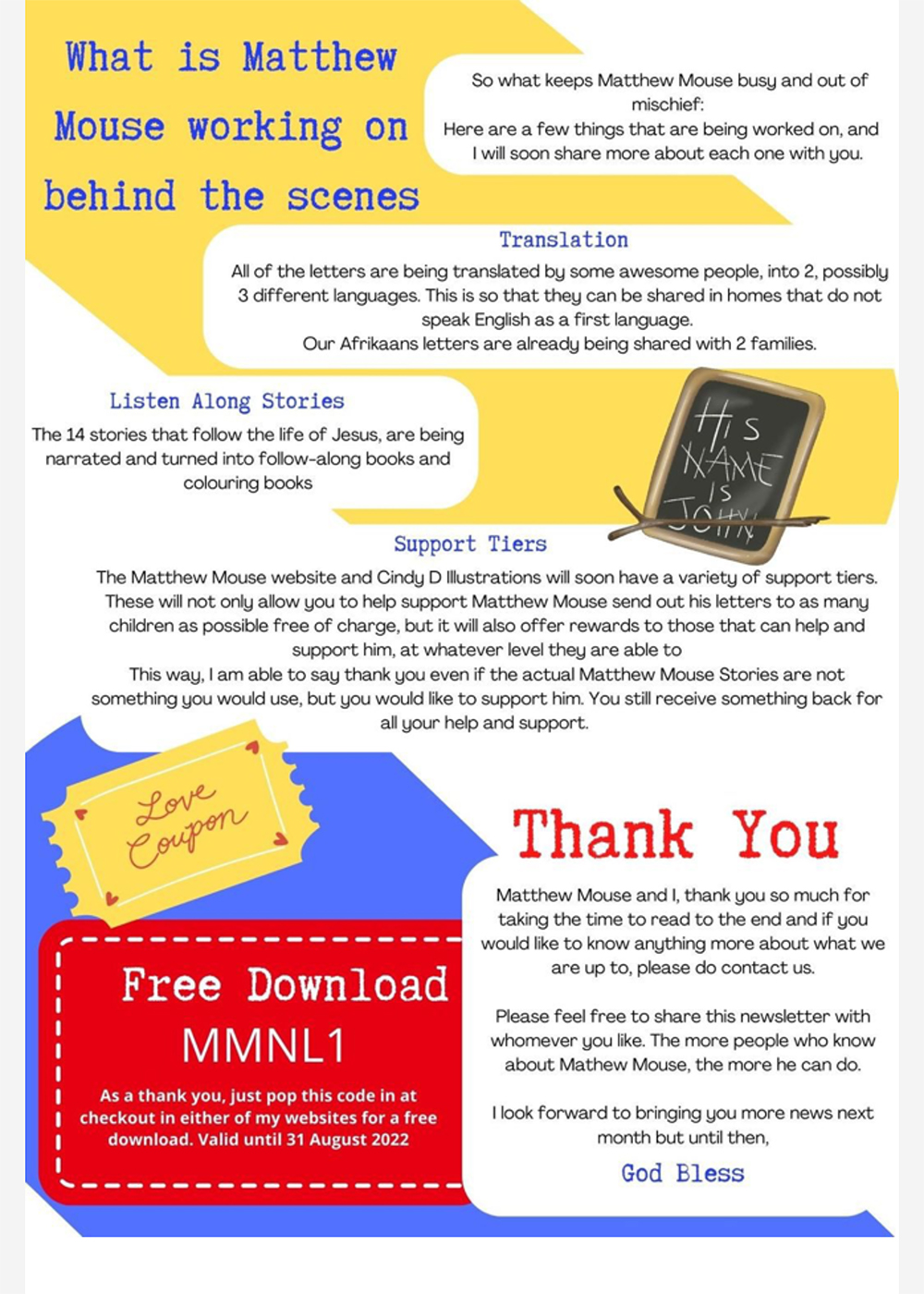
Matthew Mouse Newletter

Welcome to Matthew Mouse's first ever newsletter!

matthew mouse nletter p1

matthew mouse nletter p2

matthew mouse nletter p3

To find out more about the wonderful work of Matthew Mouse, visit his website

Memorial Service

Rosedale Community Church held a special Memorial Service on Sunday 17 July.

The service was open to everyone who have lost loved ones, but particularly remembering those who have died since the onset of the Covid pandemic in March 2020.

Rosedale is part of The Connexion's group of 22 churches and is based in Cheshunt, Hertfordshire. The church holds services every Sunday at 10.30am and Evening Prayers via Zoom at 7pm.

They also welcome members of the community - of all ages - for a variety of activities during the week, from Parent & Toddler Groups to Young and Heart and Walks for Wellbeing.

To learn more about Rosedale and their Pastor, Bethany Green, visit their website www.rosedalechurch.org and their YouTube page (see link below) which features a video about the church and weekly sermons.

Rosedale Community Church on YouTube


Preaching Pictures

Ben Quant, Connexion Trustee, writes about four different approaches to preaching, inspired by Thomas Long, author of The Witness of Preaching:

At a pre-pandemic minister's gathering some years ago at Heigh Leigh, we discussed what it was that attracted us to The Connexion, what made it special. Various responses were given, one of which was our commitment to the Bible and preaching.

Across our churches, on almost all Sundays, we will either sit down and listen to a sermon or stand up to preach it. The length may differ, as may its style and language, but the fact that there will be one is something that we take for granted and have in common. I wonder, though, how many of us have actually thought about what a sermon is? What is the point of a sermon? How do they work? Why do we listen to them? I suspect that for most of us, although we may have enjoyed or endured more than we can remember, bizarrely, the answer will be no. Perhaps you think that it's obvious what's going on, and that everyone sees it the same way. If that's so, you may be surprised to discover that this is not the case! In fact there is a whole academic field devoted to the topic of preaching, exploring what preaching is, how God speaks through a sermon, and the different ways or forms of preaching: the field of homiletics. 

Thomas Long, an American preacher, is one of the leading figures in homiletics over the recent decades. In The Witness of Preaching  he describes the main approaches to preaching through a series of pictures: the preacher as the herald, the pastor, the storyteller/poet, and the witness.

The Herald

This is the traditional understanding of preaching in evangelical circles. Here the preacher is seen as like a herald or town-crier declaring important news to those around them. They are given the task of announcing the good news of Jesus Christ as found in scripture to those to whom they are sent, believing that when the scriptures are faithfully preached, God will speak through its words to the congregation. This model of preaching emphasises the careful study of the biblical text and proclaiming it clearly, so that its meaning is conveyed to the congregation. Sermons are usually made up of a linear series of points, for example the classic 'three point sermon', with most of the focus on education rather than entertainment (although there might be humorous alliteration in the titles, or a story or joke to help make the point clear).

 the herald

The Pastor

Another common image is the pastor. This shouldn't be surprising, after all throughout the Bible religious leaders are compared to shepherds, those with the job of caring for the sheep. Jesus, of course, described himself as the Good Shepherd. With this emphasis on caring for others, inevitably some leaders bring this pastoral role into their preaching. This subtly shifts the focus from faithfully delivering the message of scripture, to discerning and meeting the needs of the flock; the purpose of preaching is to communicate the message of the Bible in such a way that it addresses people's situations and needs to help them live lives that glorify God.

So what do pastoral sermons look like? Although they are often expository like those under the herald model, they usually require more thought about communication techniques and the way the sermon is constructed (its form), because they're seeking to bring about change in their hearers, not just a greater understanding.

storyteller

The Storyteller/Poet

Once upon a time... There's nothing l like better than being told a story or reading a gripping novel. A good story has the power to transport you, to move you, to talk to you at a level deeper than words. Think of the difference between listening to a story and being told what a story is about. These are two completely different experiences aren't they! The first is full of life, and the second, even if it is accurate, totally lacks the punch or emotional impact of the story itself. 

Long's third image is that over the preacher as storyteller or poet. This approach seeks to take seriously the suggestion that most of the Bible is either a narrative, a story, or grows out of a narrative, the story of God's creation and salvation. As an approach it encompasses a wide range of forms.

When preaching, such preachers may try to pay attention to what the Bible is seeking to do to us on an emotional level as well as what it is seeking to tell us on an intellectual level, and reflect that in their sermons. They may craft their sermons not as a series of static points, but with a sense of flow or movement.

Others, rather than presenting the conclusions they reached in the study in preparing for the sermon, might recreate that journey, so that they too experience the whole 'story' rather than just the final page of conclusions. Often, just as a story might leave its listeners to work out for themselves what it means, these sermons are open-ended, encouraging and leaving room for their listeners to think through their own conclusions and responses.

Sometimes the sermon is a story, but it doesn't need to be, the key thing is that the preacher takes seriously the narrative nature of the Bible, the power of narrative, and the experiential aspect of a sermon.

witness

The Witness

Probably the most common form of storytelling is one that starts not 'once upon a time' but 'you'll never guess what happened to me today...' This final approach to preaching argues that this is the story the Bible tells. It is not simply a story amongst other stories, it is a very specific story, the account of God's dealings with his people as told by them. His people witnessed him and his acts and the Bible is their testimony.

The witness model of preaching says that as we read the eyewitness accounts of God, we open ourselves to encountering him for ourselves in their accounts. The preacher is sent by the congregation to scripture to have such an encounter on their behalf, and then to come back and share what they experienced and belief about that, 'you'll never guess what happened to me today...'  They can tell it in whatever form best fits, the important thing is that the sermon grows out of their encounter with God in the text.

An interesting aspect of this approach is that it allows for us to tell different sermons based on the same passage. Different witnesses of an event will always tell different stories because they have different points of view - for example the winner of a race will retell the story of the race differently from the person behind them who came second, or someone in the crowd watching them. You can see this of course in the Bible where we have four different testimonies to Jesus in the Gospels. This may feel risky, how do I know I've got it right, but allows and calls us to be honest in our preaching, this was my encounter with God and this is what I believe he said. 

Four different understandings and approaches to preaching, all with their strengths and weaknesses. I wonder if you recognised the preachers in your church? It may be that working out how they see themselves will help you to understand what they're trying to do so you can get the most out of their talks. If you're a preacher, which do you see yourself as being? Perhaps there might be value in trying on a different outfit sometime and seeing what it's like.

Ben Quant


Don't give up!

Every week Simon Allaby creates and records a Short Thought message for The Connexion website visitors.

Each message is 60 seconds long and Simon manages to cover a huge variety of topics to engage, inspire and entertain the listener.

This week's message 'Don't Give Up' inventively compares the challenges of the Eurovision Song Contest with the challenges of prayer. 

Click on the link to hear: Don't Give Up

The recordings are posted weekly and accessed by the SHORT THOUGHT button at the top of each web page.

Check in each week to be regularly entertained and enlightened!


Hope Explored!

South Street Free Church in Eastbourne are running a new three week course Hope Explored from Saturday 18 June.

Everyone is welcome to sign up for the course, which is free of charge and will take place in the church on Saturday mornings at 10am.

It is a great opportunity to visit the church, make new friends and ask lots of questions over a cup of tea in a relaxed, friendly environment. And the theme of the course, 'What is the best future you can imagine' will no doubt prompt many ideas and discussions!

South Street Free Church is a family of people of all ages from many backgrounds and all walks of life. They come together in friendship and support with a shared love of Jesus, and provide a warm welcome to everyone who'd like to join in.

To find out more about Hope Explored and to book your place on the course, visit their website:  https://www.southstreetfreechurch.org/hope-explored/


Photo by Brooke Cagle

Serving the Community

At the heart of Rosedale's outreach programme lies a desire to engage with and serve the people around them in Cheshunt.

Rosedale Community Church is a lively, family friendly environment, led by Pastor, Bethany Green (pictured) and a strong and enthusiastic team. The church has a welcoming feel with an open style of praise and worship, and runs a variety of groups to suit a range of ages and interests.

Rosedale Groups

Butterfly Babes is a baby and toddler group that meets every Monday morning for a cup of tea, snacks for the little ones and play and rhyme time for all.

No Limits is a youth group enables the church's young people to come together in friendship to share ideas and take part in activities.

Young at Heart is a group that is popular with the 'slightly older' members. They get together every Wednesday afternoon to take part in quizzes and craft sessions, listen to invited speakers and enjoy some trips out. Young at Heart meetings are open to everyone, and there is always a plentiful supply of tea, coffee and biscuits.


Men's Prayer Breakfast is on the first Saturday of every month at a local cafe, where men from the church get together for an informal prayer meeting, bolstered by a full English breakfast - or a slice of toast!

Missions

Also close to Rosedale's heart are the number of missions they support. Being a Connexion church, they have strong links with Sierra Leone. In addition they support the work of Tearfund and Open Doors through prayer and donations.

Church Services and Sermons

Sunday Services are held at the church for worship at 10.30am, followed by Evening Prayers via zoom at 7pm.

Sermons are recorded each week and posted up on Rosedale's YouTube Page, which allows people to listen in when it suits them best. 

All in all Rosedale is a great place to be! To find out more about this friendly, vibrant church visit their website at: Rosedale Community Church


Turning the Tide

Zion Community Church has been looking to the Lord to renew and reinvigorate the church, navigating their way into the future - Turning the Tide.

Focusing on prayer, evangelism and training, the church as a whole seeks to make an impact with the gospel in St Ives and surrounding areas. 

Nearly three years ago, Zion's vision was to see the church become established by Summer 2022; growing the membership for long-term growth, supporting a full-time pastor and becoming financially self-sustaining.

Needless to say, the pandemic has challenged their planned development, but with prayer, support and determination, they are continuing with their journey.

Turning the Tide has five key areas of focus:

To build and establish our membership 

  • From local churches with sending capacity
  • By asking people intentionally to join us
  • Through the 'Friends of Zion' group


To re-focus and commit to prayer 

  • To be a church devoted to prayer
  • To pray intentionally and specifically
  • To commit to weekly prayer

 To renew our approach to evangelism

  • To study the book of Acts together
  • To pursue the 'who's your one?' initiative
  • To ensure evangelism is a central focus of church life

To engage an apprentice/trainee each year 

  • To pray and plan for the person, accommodation and financial provision
  • To support, train and send people to further gospel ministry
  • To seek to equip workers for reaching Cornwall and beyond

To further our work with the Peninsula Gospel Partnership (PGP)

  • To partner with PGP churches around Cornwall
  • To serve other churches as we are able to
  • To work together to see our county reached with the gospel.

Achieving Turning the Tide depends on people who will:

  • Pray for the church and it's future
  • Join the Zion community
  • Provide support, giving and training

To find out more about Zion Community Church and their Turning the Tide mission, visit their website: https://zionchurchstives.org/turning-the-tide/

Big things for Us!

The Countess Free Church is a Connexion church in Ely with big ambitions to strengthen community and encourage discipleship.

Karl Relton, Minister, describes CFC, ‘As a people called together to be a local church, we try to be attentive to the Spirit’s leading, ready to pioneer to new places and ministries. Sometimes this involves listening to and speaking into the culture around us. We reach out, sensitively yet confidently, telling about Jesus through what we say and do. We are about forming community, working like an extended family that is glad to invite others in. We look to nurture faith in all ages, newcomers and the older and wiser.’


Big things for us!

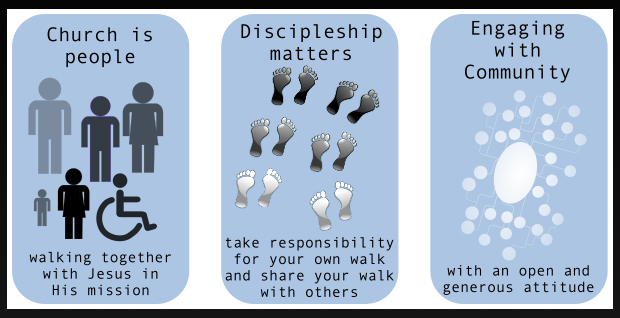
CFC's mission, 'Big things for us as a church' focuses on three key areas:

Church is People – walking together with Jesus in his mission

Discipleship Matters – take responsibility for your own walk and share your walk with others

Engaging with Community – with an open and generous attitude

  • Encouraging each person to be actively involved, inviting people to volunteer early on
  • Valuing children, their exploration and their own expressions of faith
  • Encouraging individuals to take seriously their spiritual rhythms and life, paying attention to their gifts and calling
  • Encouraging each person to be accountable, within prayer partnerships
  • Fostering a mentoring and apprenticeship culture and recognising that we are all learners
  • Developing leadership abilities across all members
  • Valuing our engagement with the community, which happens in diverse ways
  • Looking to minister to people right where they are at

The Countess Free Church is based in 10 Chapel Street, Ely, Cambridgeshire, CB6 1AD

Visit their website to find out more information about the church and community: https://www.countessely.co.uk

  • 6
  • 7
  • 8
  • 9
  • 10
  • 11
  • 12